
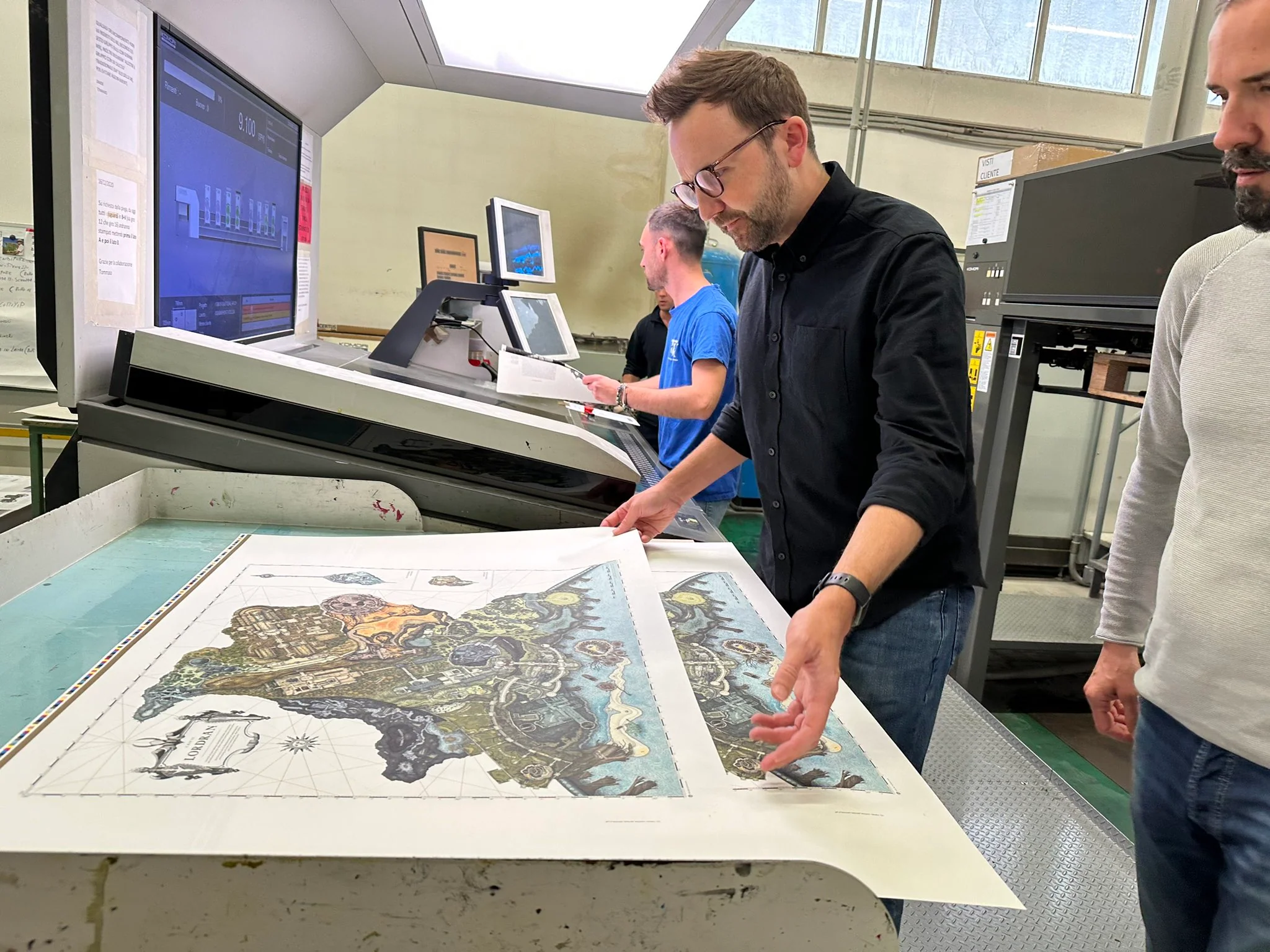
Squeaky: I see that you often wear “different hats” so to speak, when developing your projects. What do you focus on first when you start working on a project? Do you focus on art, music, the game concept or something else?
Judson: I usually have a large part of the experience in mind when I start designing a game. The second I have a kernel of an idea, I find it hard to prevent that from growing into a full experience in my head – from the mechanics to the art to the marketing. It all feels like part of the same whole to me. It’s systems thinking – everything is connected and needs to be considered in tandem!
Squeaky: What inspired the game, Deep regrets?
Judson: The obvious one that everyone spots immediately is the video game Dredge! I played it a few years prior and I found the setting and concept really inspiring. I was already dead obsessed with sea horror and creepy fishing villages and the like, and Dredge did a good job of marrying that all up into a neat little gameplay experience. I wanted to do something similar in the board game space, but put my personal stamp on it – which is much more comical and chaotic. There are plenty of other video games that were big inspirations for it, most notably Bloodborne, Sunless Sea, Subnautica and The Sinking City. There’s a lot of Annihilation (2018) in there, and a lot of Scooby Doo. And of course, I was inspired by plenty of board games, Wingspan chief among them (none of the other Span games were out when I started work on it). Love what Elizabeth Hargrave did with the design of that game – the massive variety especially was a big inspiration to me.
Squeaky: Can you walk me through your development process? For example, what was the development process for your game, Deep Regrets?
Judson: I kind of touched on this earlier, but after the initial conception I move swiftly into design and art direction simultaneously. I’ll put a sharpie prototype together, but I’ll also mock up some early card designs to get a feel for how I want it to look at feel. I try not to do too much art too early, but I like to be at least thinking about it in conjunction with the game design so it all feels unified. It’s a fail-fast approach – create the roughest thing you can, play it with other people early, learn, iterate.
Squeaky: What tips and advice would you give to someone developing their first project?
Judson: START SMALLER. Same advice I should’ve taken myself. I don’t know a single designer that did something small and manageable for their first game. I, for example, played Trickerion and was like “I’m going to make a game like Trickerion” (a famously heavy game with a LOT of systems). Of course that all blew up in my face. Turns out nailing a heavyweight Euro on your first go is easier said than done. There are SO MANY things you’ll need to learn that aren’t even related to the game design itself. It will all become crushing if you don’t pace yourself. Start small with the game, learn the workings of the industry, learn how to network, build an audience and market a game – then come back and work up into larger games. Be okay with failure and take good learnings from it. Fail small and fail fast.
Squeaky: What advice would you give to a creator polishing a project?
Judson: Don’t strive for perfect, it doesn’t exist. The old adage “great is the enemy of good” can be very true when finalising a project. Imposter syndrome can feed into that, as well. All of it boils up nicely together in a horrible jambalaya of never releasing the game. Know when you project is ready to be set free and just… let it go. If you’re happy with it and play testers enjoy it and you’ve fixed as many typos and inconsistencies as professional proofreaders can find – it’s done. Let it go.
Squeaky: How do you determine when your project has had enough testing and adjustments and is ready to be published?
Judson: You might start getting fewer comments and suggestions from play testers as you get closer to “done”… or you might not. There are a lot of reasons people give feedback and one of them can be that they’re very excited and inspired by the game and it set their creativity in motion. Getting a slew of excited ideas from play testers might counterintuitively be a good indication your game is ready for mass consumption. It really helps to get feedback in person so you can read the room – these same comments might feel destructive if they were delivered via email. I think someone with more games under their belt would have better perspective on when it’s ready to be published, but my approach is: the game should meet your personal vision, the game should be fun and the game should feel balanced. Feel being the key word. I incorporate a lot of luck into my games because I think it’s important to creating a fun, approachable experience for all skill levels. Balancing luck can be difficult. So the aim is to create an experience that feels fair to all players, regardless of what’s going on under the hood – that no decisions are just clearly stronger and that all players feel they have an equal opportunity to win or can see what mistakes they would have avoided to improve if they played again.
Squeaky: When you get a new project idea, do you shelf it for later or do you start working on it right away?
Judson: I tend to have a few ideas on the go and I might work on them all for a bit, to get a feel for what I’m most excited about and what feels most marketable. Eventually I make a decision about where my focus should be and then I dedicate myself to that game until it’s done and delivered before I move back to one of the other projects or start developing new ideas.
Squeaky: For people that are building multiple skill sets at the same time, what advice would you give them on growing their skill sets evenly?
Judson: Build a support network. Ask for help. Don’t suffer in isolation. Some of the stuff you need to learn is difficult and opaque and having someone who has done it before create transparency can save so much suffering and headaches. I found this in a few places: board game design groups on Facebook, board game design communities on Discord, and local board game designer meet-ups.
Squeaky: Do you have tips on the most efficient way to build a skillset?
Judson: Do learn. Don’t read about the thing, do the thing. Be bad at it for long enough and you’ll start being good at it. People often get frustrated with the mastery curve but the reality is all skills take time to develop and you’re going to have a taste-skill discrepancy for a long time before you’re able to achieve the results you expect out of yourself. Again, be okay with failure and have a growth mindset.
Squeaky: How did you build your community for your projects? For example, what is the process that you use to gain more awareness on your projects?
Judson: A large part of of this was in the groups of fellow game designers I mentioned. All of those people are board gamers, too! Developing camaraderie with other designers is a great way to discover some projects you’ll really love and feel like you were part of the process along the way. I love supporting creators I admire and want to see succeed and so do other creators. A lot of those creators are also influencers and if they think what you’re doing is cool, they’ll have a hard time staying quiet about it. So, start with makers and move into players! Going to conventions and meet-ups is important, too. Being seen as a flesh and blood human being and playing your game with people helps build up life-long fans. Obviously, utilising social channels like Insta/FB/Tiktok if a good way to grow your audience, as well – post like hell, ask questions, share your process, bring people on the ride. Then when you’ve got a budget, start using paid marketing to expand that audience to a larger scale.
Squeaky: How do you balance different projects that you develop at the same time?
Judson: I try to stay focused on one. If I’m feeling burnt out on it, I might spend a week doing some art or design for a different project to freshen up and then come back to it, but I’m pretty good about following through to delivery.
Squeaky: What is the production pipeline for your projects?
Judson: This is all relatively new to me, I’ve only been doing it full time for about three years now, but generally I aim to have on project in active development and a roadmap for the next year with a backlog beyond. So, for example, Even Deeper Regrets is currently leaving the production pipeline. It’s in proofreading and will be moving to localisation soon, all art and design is complete, so I’m very hands off with it at this point beyond community management and customer service. I’ve moved into heavy development on Personal Demons, which is aimed for Kickstarter mid 2026 and then I hope to come back to the 900 pound gorilla I mentioned earlier in 2027 (it’s called Fright House).
Squeaky: What project management system do you use? What beginner friendly tools do you recommend for people balancing multiple projects?
Judson: I don’t have a major need for project management because I’m a team of one. I’ve used JIRA, Asana, Confluence, Float, Basecamp and ClickUp in my corporate career (weirdly never touched Monday) but the only one I use now is Trello – it’s free and it’s simple and it’s all I need it to be. Basically a To-Do List with buckets you can move the list items between. If you have a team and need to manage workloads and multiple projects, you’ll find Trello lacking. Something with a decent gantt chart will be helpful. Don’t use JIRA, it’s so heavily geared towards software development – any of the others are probably fine, just shop around and see what aligns with the way you work. I think Monday and Basescamp are the most approachable and affordable.
Squeaky: I have heard many people in the industry tell me to specialize in one skill versus being able to do everything (I rebel against this notion personally because I struggle to stick to one lane). What is your opinion on this?
Judson: I think both have their advantages and will suit different personality types in different ways. Being a generalist is great for me because I have absolutely no attention span and very poor focus and having a million roles I need to fill gives me a lot of places I can bounce around and still be moving my business forwards. All of my productive procrastination is still on important things that need to get done. If I get distracted from invoicing because an email comes in and I wind up on drawing demons for a week as a result – that’s still something that needed to get done. Invoicing will be there when I get back. People with very strong focus may find the world of a generalist infuriating and will probably operate better as a specialist. Being constantly pulled away from what they’re trying to achieve to do something that’s not the priority will feel infuriating. However, if you’re a specialist and you’re trying to self publish board games, you need CAPITAL. If you can’t do it, you need money to pay someone who can. Being able to wear more hats will be invaluable to budding designers that don’t have the funds to tack on partners to help with the things they can’t or don’t want to do.
Squeaky: With so many projects in the air, the chance of burnout can be quite high. What things do you recommend to do to avoid burnout?
Judson: Ask me later! This career shift has been so great for me – my job is now the thing I enjoy most (which comes with its own set of problems). I have to kind of force myself to enjoy my down time and play video games or watch movies and keep the “oooh, I could draw a bunch of fishing rods” thoughts out of my head. The only bit of it that feels like it could lead to burnout at this stage for me is the community management and customer service aspect. Running customer service for 15,000 people as a single individual can be overwhelming and I may honestly have to hire someone to handle it at some point. I guess the advice I should give and take myself is: it’s okay not to respond to every message on every platform and it’s okay to have a customer that’s angry at you that you can’t placate. It doesn’t make you a bad person.
Squeaky: How did you recover when you had burnout periods? (if you have had any)
Judson: All my burnouts were in the corporate marketing world prior to leaving to start my own business and most of them dealt with having too many direct reports and trying to juggle management responsibilities (which I prioritised) with day to day responsibilities. I was hard on myself and often sacrificed my own needs for the needs of those in my reporting line and it just wasn’t good for my mental health. Travel is the best cure for burnout, in my experience. Taking time to step not just away from the work that is burning you out but to step fully out of your own day to day context and experience something novel – that’s what really helps your mind to reboot and purge that bad data.
Squeaky: What tips do you have for people who want to be a full-time creator?
Judson: Have a plan for dealing with isolation. This was my biggest concern when I decided to go into business for myself. I learned during lockdown that I do NOT deal well with working in isolation. I’m a people person who struggles with depression and anxiety and all of that spikes when I’m sitting at home in my office by myself for weeks on end. At first, I started trying to socialise more with friends and go to board game meet-ups in the evenings. It helped, but not from a professional perspective – I missed being surrounded by people in my discipline that I could lean on for day to day support. I was fortunate enough to have other board game designers in town, Eerie Idol, and I now share an office space with them. It’s been fantastic and has all the perks of being in a team even though we each have our own business. If you’re also a people person and you’re not so lucky to have a bunch of other creators in town with offices, look into co-working spaces!
Squeaky: What unexpected things did you encounter when you started your journey in becoming a full time creator?
Judson: How quickly it would just become a job. It’s a job I absolutely adore and that I find a lot of joy in doing, but the romanticism wears off nearly instantly, once it’s your means of sustenance. I think people look at ‘dream jobs’ as some sort of perpetual euphoria. It’s still a job that has to be done and there are still hard days and difficult challenges to deal with and some of them will hurt a lot more because it’s something you’re so passionate about. That first Kickstarter is a rush, you’re telling everybody you know about your Kickstarter and getting all your friends and family to pitch in to help and ride the wave of excitement. Then suddenly Kickstarters just become part of the job and you’re trying as hard as you can to hide your Kickstarters from anyone you know in person because it’s weird as hell having your finances that publicly visible to your close friends and family. There are still things that feel magical to me, like the art and early playtesting – watching a thing take shape. And there are things that make me want to claw my eyes out – like tariffs.
Squeaky: What other tips or advice would you give to someone wanting to enter the game development field?
Judson: Be practical, objective and passionate. You are almost certainly going to have a skewed perception of the viability of your game or your business model because you’re passionate about it, I know I did. I saw million dollar Kickstarters for awful looking games and was “I can trounce that”. Then I struggled to hit a (very poorly set) 30k funding goal and spiraled. There are so many factors that go into success and frustratingly, a big one is luck. It’s like going viral. You can work hard and do everything right and have a decent return but you can’t just conjure up a huge success. The fucking stars have to align and the sky splits open and an eldritch hand reaches down and touches your forehead and you hear the words “anung un rama” and BOOM you’re a massive hit. So do it because you love it. If you manage get rich doing it, that’s just a useful byproduct of your love.
Squeaky: Are there any tips or advice that comes to mind when talking to someone who is trying to make it in the gaming field?
Judson: (this feels like a repeat of the above and I think that was a good mic drop)
Leave a Reply